Liquid-applied flat roof waterproofing
San Francisco roofs are crowded: parapets, skylights, mechanical curbs, conduit, solar stanchions and drains, often on a roof the size of a living room. Every one of those details is a seam in a sheet membrane. A liquid membrane doesn’t have seams.
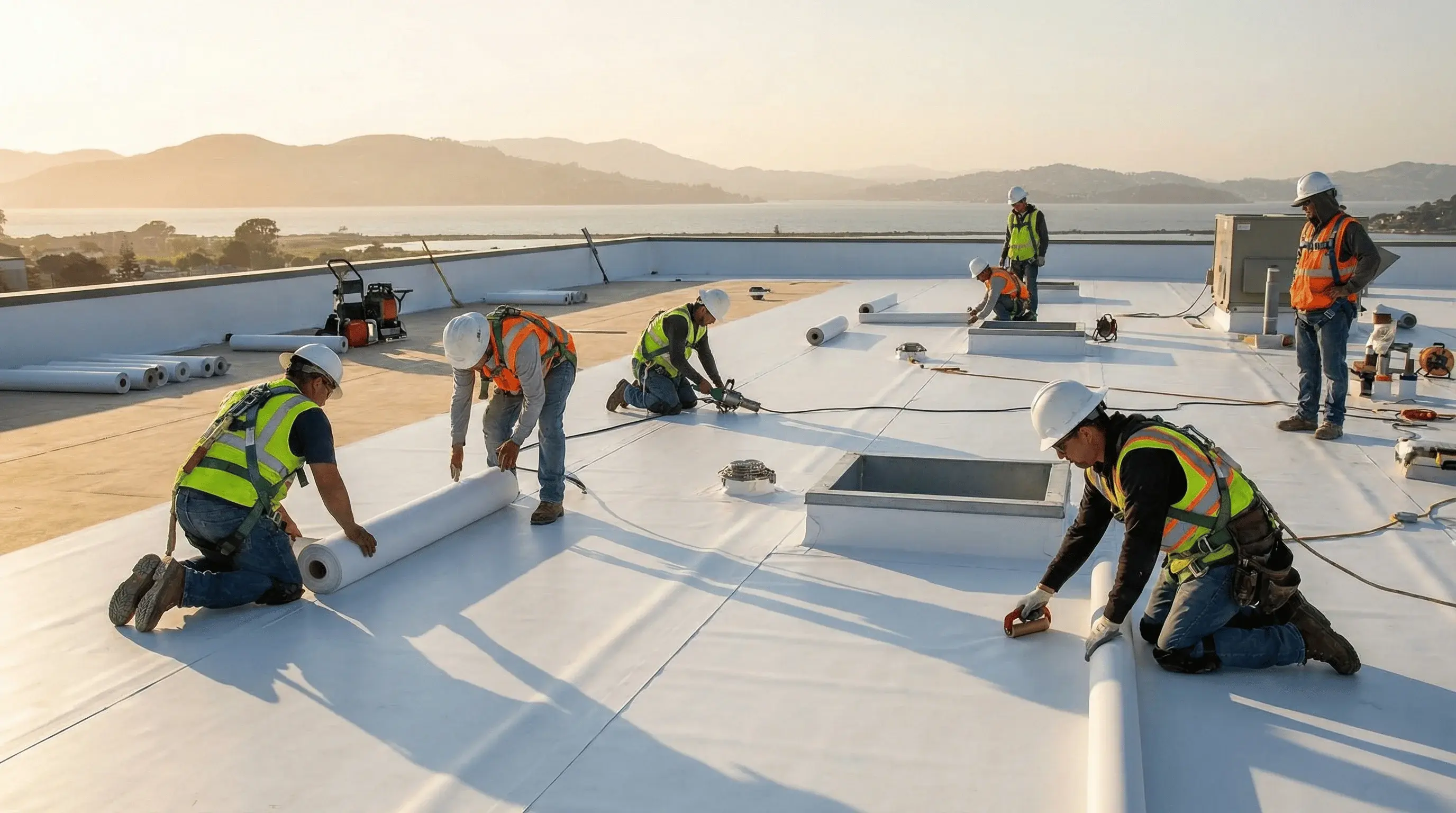
We install Kemper System’s cold liquid-applied, polyester-fleece-reinforced membranes as an Approved Applicator. The resin is applied, the fleece is embedded wet-on-wet, and the result is a single monolithic membrane that wraps every detail continuously.
Fleece-reinforced liquid membrane
- Small, detail-heavy city roofs
- Roofs with many penetrations or solar mounts
- Parapet walls and curbs
- Roof-to-deck transitions
- Green roofs and planters (root-resistant systems)
Built to stay watertight, not just look finished.
Seamless by design
There are no lap seams or welds to fail. The membrane is continuous from field to flashing.
Self-flashing details
Penetrations, drains, parapets and odd geometry are flashed with the same reinforced resin as the field — no pre-formed boots to come loose.
Fully reinforced
The polyester fleece gives the membrane tensile strength and a consistent, measurable thickness everywhere.
Cold-applied
No torches or kettles on the roof. That matters on wood-framed buildings and occupied properties.
Reflective options
Light-colored, cool-roof-rated finishes are available where California’s Title 24 energy code applies.
Long warranty paths
Kemper System offers watertightness warranties on qualifying, fully reinforced systems — issued only through Approved Applicators like us.
Fleece-reinforced liquid membrane
Cold liquid-applied resin with a polyester fleece embedded wet-on-wet — one seamless, fully reinforced membrane that wraps parapets, drains and penetrations without a single lap seam to fail.
Layer by layer, from the substrate up
- 01Structural roof deckConcrete, plywood or cover board
- 02Insulation & cover boardTapered where drainage needs correcting
- 03PrimerChosen after adhesion testing
- 04Resin — saturation coatApplied wet to receive the fleece
- 05Polyester fleece reinforcementEmbedded wet-on-wet, overlapped at laps
- 06Resin — top saturationFully encapsulates the fleece
- 07Surfacing (as specified)Reflective finish or wearing surface
Our process
01
Survey and test
Core cuts or moisture survey of the existing roof, drainage review, and adhesion tests on the substrate we’ll be bonding to.
02
Prepare and detail
Remove failed material, correct ponding with tapered insulation where needed, prime, and flash every penetration first.
03
Install wet-on-wet
Resin, fleece and top saturation go down in one continuous operation, with laps overlapped and every coverage rate checked.
04
Inspect and document
Visual inspection, thickness verification and a photo record of every detail before surfacing and closeout.
What we check on every job
- Resin consumption tracked against the manufacturer’s coverage rate
- Fleece laps overlapped to the system requirement — no butt joints
- Every penetration flashed in the same reinforced system as the field
- Substrate moisture and adhesion confirmed before priming
- Ponding corrected with slope, not with extra coating
When to call us
- Leaks around skylights, curbs or conduit
- Blistered or split seams in the existing membrane
- Ponding that never fully dries
- Repeated “patch” repairs at the same detail
Flat & low-slope roofs: questions & answers
Straight answers from the people who do the work.
How is a liquid membrane different from a roof coating?
A coating is a protective layer, usually over an existing roof. A fleece-reinforced liquid membrane is the waterproofing itself: reinforced, built to a controlled thickness and detailed like a new roof.
Can it go over my existing roof?
Often, if the existing roof is dry, sound and well attached, and the manufacturer approves the substrate. Wet insulation or delaminated layers have to come out first. We confirm with cores and adhesion tests.
Is it safe to install on an occupied building?
The Kemper System polyurethane resins we use are solvent-free and cold-applied — no open flame. Fast-curing PMMA versions have a noticeable odor during application, so we plan air intakes, windows and timing with you.
Can it handle foot traffic or pavers?
Yes. Wearing surfaces can be added over the membrane for walkways and roof decks, and the system can be used beneath pavers, tile or planters.
Read before you decide
Waterproofing · 3 min read
Deck coatings compared
Three families of walkable waterproofing cover Bay Area decks and balconies: how each is built, where it shines, and what to ask before you choose.
Waterproofing · 2 min read
Fleece-reinforced membranes: why details stay dry
How fleece-reinforced membranes such as Kemper System’s KEMPEROL work on crowded roofs and tiled balconies, and what Approved Applicator means for the warranty.
Waterproofing · 2 min read
Is a roof coating right for your flat roof?
Silicone and elastomeric coatings can add years to a sound flat roof, or trap water in a wet one. How to tell, and what a restoration includes.
Let’s keep the water out — for good.
Tell us what’s going on. We’ll inspect, explain what we find with photos, and give you a written, fixed-price proposal — usually within 48 hours of the visit.