Waterproofing, specified and tested to last.
Decks over bedrooms, podiums under planters, flat roofs crowded with penetrations: each needs a different system. We install the right one — from manufacturers we’re certified with — and we prove it works before we leave.
Gaco Qualified Applicator. Kemper System Approved Applicator. California C-39 #1138836.
Fleece-reinforced liquid membrane
Where we waterproof.
Every application below has its own page with the system build-up, our process, quality checks and FAQs.
Decks & balconies
Walkable waterproofing for decks and balconies over living space, flashed, reinforced, flood-tested and documented by a Gaco Qualified Applicator.
Learn moreFlat & low-slope roofs
Seamless, fleece-reinforced liquid waterproofing for flat and low-slope roofs, installed by a Kemper System Approved Applicator in the Bay Area.
Learn morePlazas, podiums & planters
Protected-membrane waterproofing for podiums, courtyards, planters and green roofs, specified for the overburden and tested before it is buried.
Learn moreBelow-grade & foundations
Positive-side waterproofing for foundation walls, retaining walls and basements in the Bay Area: membrane, protection and drainage as one system.
Learn moreParking decks & garages
Vehicular traffic coating systems for parking decks, ramps and podium garages in the Bay Area — waterproofing that protects the slab and the space below.
Learn moreRoof coatings & restoration
Silicone and elastomeric restoration for sound, aging flat roofs in the Bay Area, repaired, adhesion-tested and coated to a verified thickness.
Learn more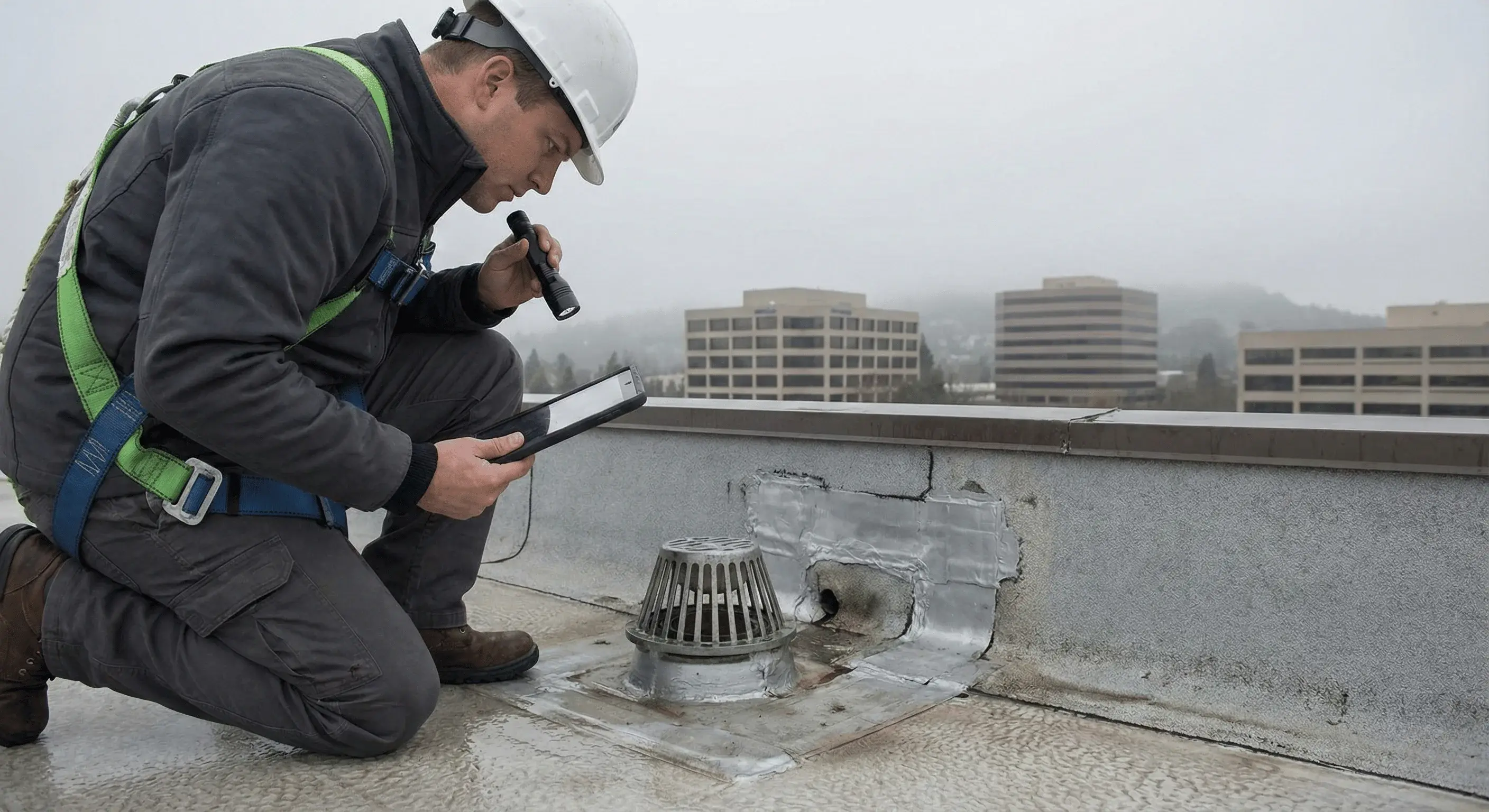
Leak investigation & testing
Leak investigation for decks, roofs, walls and windows in the Bay Area: controlled water testing, flood testing and photo-documented findings.
Learn moreSomething else leaking?
Window-to-deck transitions, roof-to-wall joints, stairs, walkways — if water is getting in, we’ll find where and recommend the fix.
Premium systems, installed by approved applicators.
We install complete systems from manufacturers who train and approve their applicators — so the product performs as tested, and the warranty is real.
Gaco Qualified Applicator
GacoFlex
Elastomeric urethane deck systems and 100% silicone roof coatings.
Polyurethane, silicone and polyurea elastomeric coatings
Explore GacoFlexKemper System Approved Applicator
Kemper System
Cold liquid-applied, fleece-reinforced waterproofing membranes.
Fleece-reinforced polyurethane and PMMA resins
Explore Kemper SystemCalifornia C-39 Roofing Contractor
License #1138836. California’s C-39 classification covers both roofing and waterproofing — the work of sealing, waterproofing and weatherproofing structures. Verify it any time on the CSLB website.
California Contractors State License Board (CSLB)Verify
Gaco Qualified Applicator
Recognized by Gaco to install GacoFlex urethane deck systems and silicone roof coatings, and to register eligible projects for Gaco labor-and-material warranties.
GacoDetails
Kemper System Approved Applicator
Trained on the job by Kemper System and retrained every two years, as Kemper requires. Approved Applicators are the only contractors who can register Kemper System warranties.
Kemper System AmericaDetails
Licensed, bonded & insured
General liability and workers’ compensation coverage on every project, plus a written Skyline workmanship warranty. Certificates of insurance are available for owners, HOAs and property managers.
Skyline Roofing & Construction
Best practices, written down and followed.
Most waterproofing fails because of preparation, details or thickness — not the product. Our standard covers all three, before, during and after installation.
01
Before we install
Most waterproofing failures are decided before the first coat: by the substrate, the slope and the details.
- Diagnose before we prescribe
- Specify the system to the substrate
- Slope to drain — 1/4" per foot wherever possible
- Test moisture and adhesion
- Prepare the surface to spec
02
While we install
A membrane is only as good as its thinnest spot and its worst detail.
- Details first, field second
- Complete manufacturer systems only
- Measured thickness on every coat
- Respect cure and weather windows
- Flashings go under, not on top
03
Before we call it done
We prove the system works and leave you with the records to keep it working.
- Test before it’s covered
- Document everything
- Register the warranty
- Plan the maintenance
From leak to warranty.
01
Assess
Inspect, open up details, and test moisture and adhesion where needed.
02
Specify
Recommend a specific manufacturer system, with a written, fixed-price proposal.
03
Install
Details first, then the field — with thickness measured and photographed.
04
Test & document
Flood or electronic testing where applicable, then closeout and warranty.
Know what you’re buying.
Waterproofing · 3 min read
SB 721 and SB 326 balcony laws for Bay Area owners
Both first-round balcony inspection deadlines have passed. What SB 721 (apartments) and SB 326 (condos and HOAs) require, and how waterproofing fits the repair.
Waterproofing · 3 min read
Deck coatings compared
Three families of walkable waterproofing cover Bay Area decks and balconies: how each is built, where it shines, and what to ask before you choose.
Waterproofing · 2 min read
Flood tests before waterproofing is covered
Once tile, pavers or soil go down, a membrane defect is expensive to find. How ASTM D5957 flood testing and ASTM D7877 electronic leak detection work.
Waterproofing questions
What’s the difference between waterproofing and roofing?
Roofing sheds water on surfaces nobody walks on. Waterproofing keeps water out of surfaces that are walked on, buried, tiled over or held under water — decks, balconies, podiums, planters and foundations. In California both fall under the C-39 license, and the transitions between them are where leaks most often start.
Which waterproofing system is right for my project?
It depends on the substrate (plywood or concrete), what goes on top (nothing, a wearing surface, tile, pavers or soil), traffic, exposure and access. We assess first and recommend a specific manufacturer system — and tell you why.
Why does it matter that you’re a manufacturer-approved applicator?
Manufacturers like Gaco and Kemper System only issue their labor-and-material and watertightness warranties through applicators they have trained and approved. It also means the system is installed the way it was tested.
Do you test the waterproofing?
Yes. Horizontal waterproofing over occupied space is flood-tested (ASTM D5957) or electronically tested (ASTM D7877) where the assembly allows, before it’s covered.
How long will my waterproofing last?
Service life depends on the system, thickness, exposure and maintenance. Exposed deck coatings are designed to be maintained with periodic re-top-coating; buried membranes under plazas are designed to last as long as the overburden above them. We give you a maintenance plan with every project.
Let’s keep the water out — for good.
Tell us what’s going on. We’ll inspect, explain what we find with photos, and give you a written, fixed-price proposal — usually within 48 hours of the visit.